The Sear Test Where Propane Torches Pull Away From Butane
 Sam VasquezBuying Guide Lead
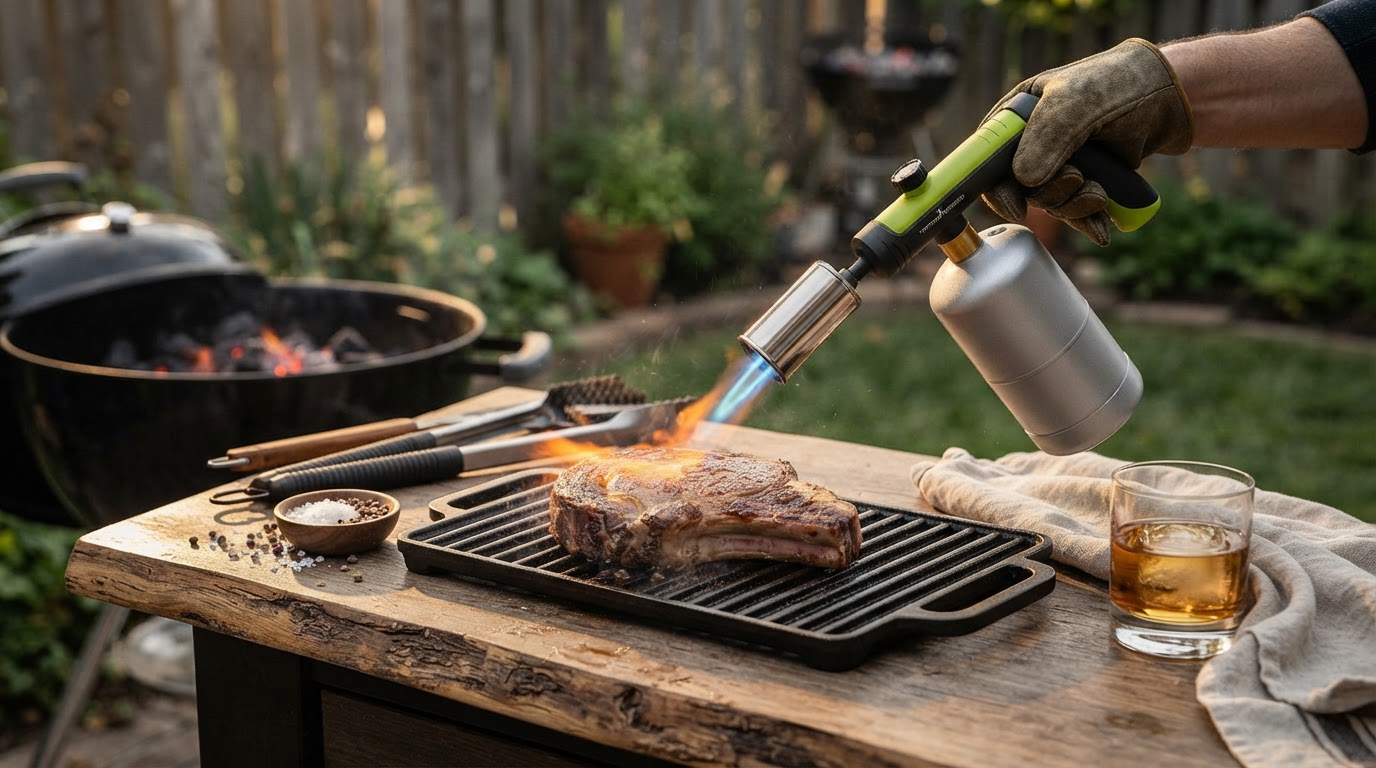
A propane cooking torch changed my steak sear time from 94 seconds to 38 seconds per side in a breezy backyard test, but the real surprise was not speed — it was control. The adjustable propane torch did less scorching than a small butane culinary torch because I could stand farther back, use a wider moving flame, and avoid drilling one pencil-hot point into the meat.
That runs counter to the way many people shop for cooking torches. They compare flame temperature, see that both butane and propane can make impressive blue flames, and assume the smaller kitchen torch is the more precise tool. In outdoor BBQ, I’ve found the opposite is often true.
Below is my comparison framework for three common ways to add direct finishing heat: an adjustable propane cooking flame torch, a handheld butane culinary torch, and a grill’s built-in sear burner or very hot charcoal zone. I’m focusing on BBQ and outdoor cooking, where wind, fuel availability, food surface area, and safety matter more than pastry-shop delicacy.
The comparison most buyers miss: heat delivery beats flame temperature
Torch marketing loves flame temperature. Propane in air is often cited around 3,600°F, and butane is in a similar neighborhood. That sounds like a tie.
But cooking is not a lab flame-temperature contest. A 12-ounce ribeye, a rack of ribs, a tray of peppers, or a smoked brisket slice does not care what the hottest invisible point of the flame can reach. It cares how much usable heat lands on the surface, how evenly it moves, and whether the flame stays stable when a breeze hits the patio.
The U.S. Energy Information Administration lists propane at about 91,452 Btu per gallon and butane at about 103,030 Btu per gallon. But that per-gallon figure can mislead shoppers because typical tool formats are different: a 1 lb propane cylinder holds far more total usable cooking energy than the small 8-ounce or pocket-sized butane canisters used for culinary torches. ASTM D1835, the standard specification for liquefied petroleum gases, also reminds us that “propane” fuel is not just a vague camping-store word; it is a standardized LPG product when sold correctly.
For an outdoor cook, the practical question is not “Which gas is hotter?” It is: “Which setup gives me enough controllable heat over the size of the food I actually cook?”
My field comparison: three finishing methods on the same grill night
Photo by Gustavo Fring on Pexels
I ran a backyard comparison using the same grill, same cutting board location, and similar ambient conditions: 61°F evening temperature, light wind between 5 and 8 mph, and steaks rested after indirect cooking to 118°F internal temperature. I compared three finishing methods:
- Adjustable propane cooking flame torch connected to a 1 lb propane cylinder
- Small refillable butane culinary torch
- Gas grill sear burner/preheated high-output zone
| Finishing method | Time to visible crust on one side | Effective flame/heat footprint | Wind interruptions | Surface result | My control rating | |---|---:|---:|---:|---|---:| | Adjustable propane cooking torch | 38–48 seconds | About 3–5 inches when swept | 0 in 6 passes | Even browning when kept moving | 9/10 | | Butane culinary torch | 85–110 seconds | About 0.75–1.5 inches | 2 sputters/relights | Spotty dark dots before full crust | 6/10 | | Grill sear burner/hot zone | 70–95 seconds | Full grate contact area | None | Strong grate marks, less edge control | 7/10 |
The propane torch was not just faster. It let me correct pale spots after the steak came off the grate. The butane torch could do the job, but it demanded constant micro-movements and was easy to hold too close. The grill sear burner made attractive marks, but marks are not the same thing as an even crust.
Propane torch vs butane torch: where the difference shows up
Surface area
A butane culinary torch is excellent for crème brûlée because a ramekin is small, sugar is thin, and the goal is a glassy top layer. BBQ foods are usually larger and wetter. A pork chop has curved sides. Chicken skin has valleys. A burger patty sheds fat. A smoked brisket slice may need edge-to-edge reheating and browning.
The adjustable propane torch wins because it can cover more surface without needing to touch the flame cone to the food. That distance matters. Standing back 4 to 8 inches with a broader flame gives me more time to react before a spot burns.
Wind tolerance
Outdoor cooking punishes small flames. In my test, a light cross-breeze made the butane torch flutter and forced me to rotate my wrist around the food. The propane torch flame was visibly more stable. This is partly because common propane torch heads are designed for outdoor utility use, not only tabletop finishing.
If you cook on a balcony or sheltered patio, butane may feel fine. If you cook near a driveway, open yard, campsite, tailgate, or beach house, wind tolerance is not a minor feature.
Fuel convenience
The 1 lb propane cylinder is easy to find at hardware stores, grocery stores, camp shops, and many gas stations. Butane cans are common too, especially in Asian supermarkets and restaurant supply stores, but the tiny refill style used for many culinary torches can become annoying when you are searing multiple steaks.
For one dessert, butane is convenient. For six burgers, four steaks, blistered peppers, and a cast-iron touch-up, propane is simpler.
Learning curve
This is where I split from the usual advice.
My take: a larger adjustable propane torch is often easier for a beginner than a tiny butane torch, provided the beginner starts with the flame turned down and keeps it moving.
The fear is understandable: propane looks more serious. The cylinder is larger, the flame is louder, and the tool feels less like a kitchen gadget. But the cooking error I see most often is not “too much total power.” It is “too much concentrated heat in one dot.” Small butane torches encourage that mistake because the user has to get close and linger.
An adjustable propane cooking flame torch lets you widen the working distance. Used like a paintbrush, not a laser pointer, it can be more forgiving.
Propane torch vs grill sear burner: the torch is a finishing tool, not a replacement grill
A sear burner or ripping-hot charcoal zone is still useful. If I’m cooking eight steaks at once, I want a hot grate. A grill gives me batch capacity and a familiar workflow.
But a grill sear zone has limitations:
- It browns where the food touches the grate first.
- It may leave pale bands between grate marks.
- It cannot easily hit the sidewall of a thick steak or pork chop.
- It can overcook the interior while you chase exterior color.
- Fat flare-ups can turn “sear” into soot.
That distinction is important for food safety. The USDA Food Safety and Inspection Service gives minimum internal temperatures such as 165°F for poultry and 145°F with rest time for whole cuts of beef, pork, lamb, and veal. A torch can make food look done before the center is safe. So I treat the torch as a surface tool and still verify doneness with a probe thermometer.
The health angle: browning is good, charring is not the goal
A useful torch comparison should talk about what happens when meat gets too dark. The National Cancer Institute explains that heterocyclic amines and polycyclic aromatic hydrocarbons can form when muscle meats are cooked at high temperatures, especially when exposed to open flame or smoke from dripping fat.
That does not mean “never grill” or “never torch.” It means precision matters. A torch that lets you brown quickly without prolonged flare-ups can be a better choice than leaving meat over an angry grease fire.
My working rule: aim for mahogany and crisp edges, not black crust as a default. If I see sticky black soot rather than browned crust, I back off, move faster, or lower the flame.
Decision framework: choose by job, not by gadget category
Here is the simplest way I compare these tools.
Choose an adjustable propane cooking flame torch when:
- You cook outdoors more than indoors.
- You sear steaks, burgers, chops, ribs, peppers, corn, or seafood.
- You want to finish food after smoking, sous-vide cooking, or indirect grilling.
- You need a flame that tolerates a little wind.
- You want fuel that is easy to buy in larger cylinders.
- You prefer a wider flame pattern and adjustable intensity.
Choose a butane culinary torch when:
- You mainly make desserts.
- You work indoors in a controlled kitchen environment.
- You need a small flame for sugar, meringue, or delicate garnish work.
- You value compact storage over outdoor power.
- You only torch one or two small items at a time.
Use a grill sear burner or charcoal zone when:
- You need to sear many portions at once.
- You want grate marks.
- You are already cooking over high heat.
- You want conductive heat from metal grates as well as radiant heat.
- You are not trying to touch up sides, edges, or uneven surfaces.
Practical technique: how I use a propane torch for better BBQ crust
A propane torch is powerful enough that technique matters. Here is the checklist I use.
Before lighting
While torching
After cooking
The National Fire Protection Association reports that grills are involved in thousands of home fires each year and consistently emphasizes keeping grills away from structures and never leaving them unattended. A torch deserves the same respect. It is not dangerous when used thoughtfully, but it is also not a toy flame for crowded prep tables.
Cost and fuel: the boring factor that affects real use
Photo by Mikhail Nilov on Pexels
Fuel cost shifts by region, but the pattern is consistent: a propane cylinder usually supports longer outdoor cooking sessions than a small butane torch reservoir. If your torch becomes part of your weekly BBQ routine, capacity matters more than the price of a single refill.
A small butane torch can feel cheaper because the initial purchase is often low. But if you regularly finish multiple steaks or trays of appetizers, you may find yourself refilling often, waiting between refills, or losing pressure as the canister cools. Propane cylinders are less fussy for this style of cooking.
There is also a psychological cost: if a tool runs out often, you stop using it. The best BBQ accessory is the one that is ready when the food hits the board.
What I would not use a propane cooking torch for
Comparison should include limits. I would not use a propane cooking torch to:
- Cook raw poultry from start to finish
- Replace temperature measurement
- Char food inside an unventilated kitchen
- Melt cheese on thin plastic serving trays
- Sear directly over a greasy wooden cutting board
- “Clean” a grill grate in place of proper scraping and heating
- Entertain kids by making oversized flames
My bottom-line comparison
If your cooking life is mostly crème brûlée, meringue, and tiny indoor garnish work, buy a butane culinary torch. It is compact and precise for that scale.
If your main goal is outdoor BBQ — steak crust, pork chop edges, blistered vegetables, finishing smoked meats, or correcting pale spots after indirect cooking — I would choose an adjustable propane cooking flame torch first. It gives you a broader heat footprint, better wind tolerance, more fuel capacity, and more practical control over real BBQ surfaces.
If you already own a grill sear burner, keep using it. But pair it with a propane torch when you care about evenness. The grill gives you mass heat; the torch gives you final editing.
FAQ
Is propane safe to use on food?
Yes, propane is commonly used as a cooking fuel for grills, camp stoves, and outdoor burners. The key is complete combustion and proper use. Use a clean, functioning torch, keep the flame moving, and do not let soot build up on the food. If you see yellow, smoky, dirty flame behavior, stop and adjust the setup.
Will a propane torch make steak taste like gas?
It should not if the torch is burning correctly and you are using it outdoors with good airflow. Off flavors usually come from incomplete combustion, holding the flame too close, or depositing soot. A steady blue flame and sweeping motion reduce that risk. Also avoid torching directly in heavy grease flare-ups.
Is a propane torch hotter than a butane torch?
In real cooking, the more important difference is not peak flame temperature but heat delivery. Both fuels can produce very hot flames. A typical propane torch setup for outdoor use usually delivers a larger, more stable flame pattern and more total fuel capacity than a small culinary butane torch. That is why it often performs better for BBQ searing.
Can I use a propane torch instead of a grill?
Not for most foods. Use the grill, smoker, oven, or sous-vide setup to cook the interior safely and evenly. Use the torch for finishing: browning, crisping, blistering, and touching up uneven spots. Always verify internal temperature with a thermometer for meat and poultry.